The Words on Your Window Quote, Translated: A Plain-English Glazing Glossary for St Clement Homes

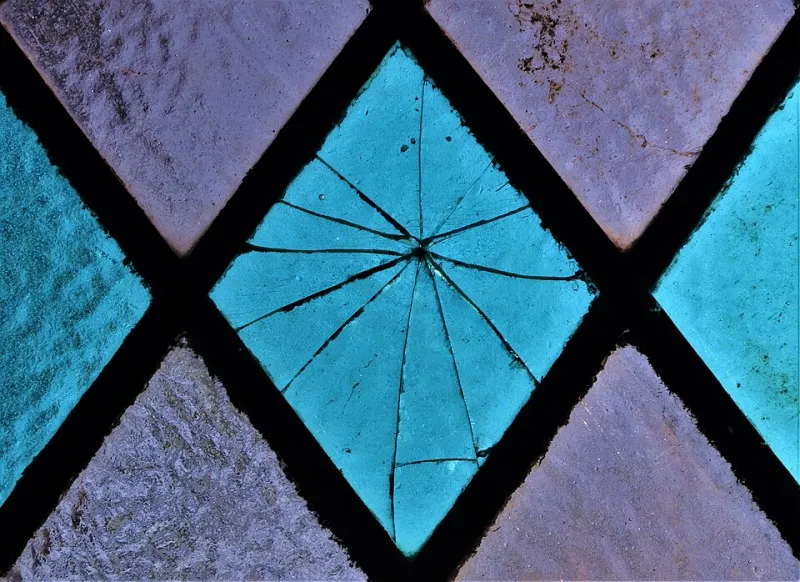
Photo: Basile Morin, CC BY 4.0, via Wikimedia Commons
You ask for a price to replace four windows. What comes back reads like the ingredients panel on a shampoo bottle. Low-emissivity coating. Argon-filled cavity. Warm-edge spacer bar. Whole-window U-value of 1.3. G-value on request.
None of it is nonsense — most of it is genuinely how a modern sealed unit is built. But a quote is a sales document as well as a technical one, and some of that vocabulary is there to make a fairly standard product feel bespoke. So here is the translation, in the order the terms actually matter to a normal house on a normal street in St Clement.
The four words that change how a room feels
Low-E coating — the invisible one doing the real work
Low-emissivity glass has a microscopically thin metallic layer bonded to one surface inside the sealed unit. You cannot see it, cannot feel it, and would never know it was there. What it does is reflect heat back into the room instead of letting it radiate out through the glass.
Almost every sealed unit sold for a home today has it. That is the important bit. It is not an upgrade — it is the baseline. If a quote lists low-E glass as a costly optional extra, ask plainly what the standard price includes, because you may be paying twice for the same pane.
The version worth knowing about is soft-coat versus hard-coat. Soft-coat performs better but has to live sealed inside the unit, which is where it lives anyway. Hard-coat is tougher and often turns up on self-cleaning glass. Neither is a scandal. Just don't let the word premium persuade you into paying for something that is already standard.
Argon — the filler that isn't a miracle
Argon is an inert gas, heavier than air, used to fill the gap between the panes. It slows the convection current inside the cavity, so heat moves across that gap a little more slowly. Krypton does the same job better in narrow cavities, which is why it appears on slim-frame and conservation-style work where you cannot fit a wide gap.
On a standard 16mm cavity, argon adds a modest improvement — worth having, usually included, rarely worth a large premium. If a quote adds a few pounds per window for gas filling, that is honest enough. If it adds a couple of hundred, ask what else is in that line, because the gas itself does not cost that.
One thing worth saying out loud: gas can slowly leak over a couple of decades, and the unit still works, just slightly less well. Nobody is coming to top it up. This is not a reason to avoid argon, only a reason not to treat it as the headline feature.
Warm-edge spacers — where condensation actually starts
The spacer bar is the frame around the perimeter of the sealed unit, the thing keeping the two panes exactly apart. Older units used aluminium, which conducts heat out of the room at the edges. That is why the bottom corners of an old window mist up first on a cold morning — that edge is the coldest part of the glass.
Warm-edge spacers use composite, stainless steel or polysulphide instead. They keep the edge of the glass closer to room temperature, which means less edge condensation and a slightly better overall figure. It is a small, unglamorous detail that quietly decides whether you spend every January wiping the same corner.
Ask which spacer is specified. Some cheap quotes still sneak aluminium in.
U-values — lower is better, and whole-window is the number you want
A U-value measures heat loss. Lower is better. As a rough scale: single glazing sits around 5.0, a tired 1990s double unit maybe 2.6 to 2.8, a decent modern double unit around 1.2 to 1.4, triple glazing down near 0.8.
Here is the trap. A glass-only figure will always flatter the product. What matters is the whole-window U-value, which includes the frame, the spacer and the glass together. A brilliant pane in a poorly fitted frame is an expensive way to stay cold.
Replacement windows in existing homes need to meet the building regulations — broadly, a Window Energy Rating of band C or better, or a whole-window U-value of 1.4 or lower. Ask for the figure in writing, along with the certification, and don't accept a verbal 'it's A-rated' as the whole answer.
Solar control — the term people ignore until July
Solar-control glass carries a g-value, which describes how much of the sun's heat gets through. Lower g-value, less heat gain. It genuinely earns its keep on a big south-facing set of doors, a conservatory roof, or a room that becomes unbearable in a heatwave.
It is also easy to oversell. Put heavy solar control on a north-facing bedroom window and you have simply bought a gloomier room. Match the glass to the room's problem, not to the salesperson's confidence.
Terms worth a raised eyebrow
'Triple glazed' on a frame that only fits a narrow cavity is a marketing phrase, not a performance guarantee. Thickness of the unit is not the same as quality of the unit.
'Self-cleaning glass' relies on rain washing across a sloped surface. On a sheltered vertical window under a deep soffit, it does very little and costs real money.
'A++ rated' without a certificate is a sticker, not a number. Ask for the documentation.
'Thermal blinds sealed inside the unit' exist, they work, and they are usually a lot of money for a modest gain. Ask what the whole-window U-value becomes before and after — that will settle the conversation quickly.
Three questions that beat memorising any of this
You do not need to become fluent. You need to ask three things and write down the answers.
- What is the whole-window U-value, and can you put it in the quote?
- Which low-E glass and which spacer bar are in this specification?
- What is already in the base price, and what have you itemised as an upgrade?
A decent installer will answer all three without flinching. Someone who gets vague about the second one is telling you something useful.
The short version
Low-E glass, argon and a warm-edge spacer are standard-issue parts of a competent 2026 sealed unit, not luxuries. The number that tells you how the window will actually perform is the whole-window U-value. Everything else is either a genuine solution to a specific problem in your house, or decoration on a quote.
Keep the paperwork, ask for the parts by name, and compare like with like. That is the whole glossary, really.